



The Work-Esteem Course Series
Available Now
Begin your Work-Esteem journey.
Apply using the Founding Cohort Application below. Once your spot is confirmed, I will add you to Work-Esteem Studio and enroll you in the course. You will then receive a welcome email from me and a separate email from Wix inviting you to create your password. Once your password is set, you can log in through the Program Portal and begin the course.

Course 1: What is Work-Esteem?


Length: 120 minutes
Price: $99
Format: Self-paced online course
Access: 45 days

A clear introduction to the Work-Esteem framework and why Work-Esteem is different from self-esteem.
Work-Esteem is your ongoing relationship with your professional work, especially how you understand your Growth, Value, and Place. In this foundational course, you will explore how feedback, performance, mistakes, relationships, workplace conditions, and the meaning you attach to professional experiences can shape the way you see yourself at work.
You will also learn how Work-Esteem and self-esteem influence one another without being the same, and begin identifying what currently supports or strains your professional steadiness.
Course takeaway:
Work can matter deeply without becoming the whole measure of your worth.
Included Resources
-
Six short video lessons
-
Guided reflection prompts
-
Downloadable Course 1 workbook
-
Relationship With My Work reflection
-
Self-Esteem and Work-Esteem Mapping Tool
-
Meaning Attachment Practice page
-
Five Roots Quick Guide
-
My Work-Esteem Snapshot
-
One Rooted Next Step activity

Growing Next
New courses are taking root.



Course 2: Identity, Performance, and Professional Worth

Understanding the difference between who you are and how you perform.
Your performance matters, but it is not the whole measure of who you are.
In this course, you will explore how professional identity, performance, feedback, mistakes, praise, comparison, and outcomes can become tangled together. When identity and performance become fused, one difficult assignment may feel like proof that you are not capable, while success may become something you depend on to feel professionally worthy.
You will learn to separate performance information from identity conclusions while remaining connected to responsibility, growth, and professional accountability. The goal is not to dismiss performance. It is to keep performance specific enough that you can learn, repair, practice, and continue developing without turning every experience into a verdict on your worth.
Course takeaway:
Your performance provides information. It does not determine your identity.
Planned Resources
-
Short self-paced video lessons
-
Guided reflection prompts
-
Downloadable Course 2 workbook
-
Identity–Performance Model
-
Who I Am / How I Perform Mapping Tool
-
Performance Information vs. Identity Meaning worksheet
-
Feedback Without a Verdict reflection
-
Comparison and External Validation Check
-
Professional Worth Evidence Map
-
Practical interpreting scenarios
-
Grounded Feedback Response Plan
Length:
Price: $
Format: Self-paced online course
Access: 45 days


Course 3: The Performance Trap Loop
Recognizing cycles of over-functioning, pressure, fear, and collapse.
Professional pressure does not always appear as stopping or giving up. Sometimes it appears as doing more, proving more, monitoring everything, preparing past the point of usefulness, saying yes beyond capacity, or trying to prevent every possible mistake.
In this course, you will learn to recognize the Performance Trap Loop and identify how pressure can move through cycles of triggering, self-monitoring, over-proving, depletion, disconnection, collapse, and renewed pressure.
You will explore your personal warning signs, the meanings that keep the loop moving, and the Work-Esteem roots that may become strained. You will also develop practical interruption strategies that support responsible action without avoidance, denial, or another round of over-functioning.
Course takeaway:
You do not have to complete the loop before choosing a more grounded response.
Length:
Price: $
Format: Self-paced online course
Access: 45 days

Planned Resources
-
Short self-paced video lessons
-
Guided reflection prompts
-
Downloadable Course 3 workbook
-
Performance Trap Loop visual model
-
My Performance Trap Loop Map
-
Pattern Recognition Worksheet
-
Trigger and Meaning Attachment reflection
-
Over-Functioning Signs Checklist
-
Early Warning Signals Tracker
-
Five Roots Under Pressure Map
-
Loop Interruption Strategy Menu
-
Rooted Return Plan
-
Pocket-sized Loop Interruption Card


Length:
Price: $
Format: Self-paced online course
Access: 45 days
Course 4: From Survival to Sustainability
Noticing where your work life is running on depletion versus steadiness.
Survival can help us move through a short period of difficulty. It becomes a problem when urgency, depletion, overextension, and constant recovery become the normal conditions of professional life.
In this course, you will examine where your work currently falls along the Survival-to-Sustainability Continuum. You will explore workload, recovery, preparation, boundaries, professional support, workplace expectations, and the difference between an individual challenge and an unsustainable system condition.
This course is not about becoming more efficient at tolerating depletion. It is about identifying what helps responsible work continue over time and creating a realistic plan for greater steadiness.
Course takeaway:
Sustainability is not doing more with less. It is building conditions that allow responsible work to continue.
Planned Resources
-
Short self-paced video lessons
-
Guided reflection prompts
-
Downloadable Course 4 workbook
-
Survival-to-Sustainability Continuum
-
Depletion vs. Steadiness Self-Check
-
Demand, Capacity, and Support Map
-
Work-Care and Self-Care Reflection
-
Energy and Recovery Audit
-
Sustainable Boundary Planner
-
Individual, Relational, and System Conditions Map
-
Sustainability Reflection Pages
-
Return-to-Steadiness Tool
-
30-Day Sustainability Plan


Course 5: Root One-Belonging

Connection, fit, isolation, and what it means to have a place in professional community.
Belonging shapes how professionals participate, learn, ask questions, receive feedback, and imagine their future within a field.
In this course, you will explore where you experience connection, where belonging feels conditional, and how isolation, comparison, workplace culture, gatekeeping, professional relationships, and community access can affect your sense of place.
Belonging does not mean entitlement to every assignment, role, or opportunity. It also does not require sameness, perfection, or approval from everyone. Healthy belonging makes room for growth, accountability, contribution, and genuine professional relationship.
Course takeaway:
Belonging does not require perfection. It requires relationship, responsibility, and room to grow.
Length:
Price: $
Format: Self-paced online course
Access: 45 days
Planned Resources
-
Short self-paced video lessons
-
Guided reflection prompts
-
Downloadable Course 5 workbook
-
Belonging Ecosystem Map
-
Place and Participation Reflection
-
Connection and Isolation Inventory
-
Conditional vs. Rooted Belonging Guide
-
Professional Community Map
-
Belonging Without Comparison worksheet
-
Ecosystem Conditions Prompts
-
“I Can Be Growing and Still Belong” grounding tool
-
One Connection Step Plan


Length:
Price: $
Format: Self-paced online course
Access: 45 days

Course 6: Root Two-Trust
Trust in self, trust in process, trust in others, and where trust gets strained.
Trust is not the same as certainty.
Professional trust includes being able to rely on your preparation, ask for help, make a decision with the information available, receive feedback, recognize uncertainty, and adjust when new information appears.
In this course, you will explore trust in yourself, trust in professional relationships, trust in the learning process, and trust within workplaces and systems. You will identify where trust has been strengthened, where it has been strained, and what evidence, consistency, boundaries, support, or repair may help rebuild it.
The goal is not blind confidence. It is grounded discernment.
Course takeaway:
Trust is not knowing everything. It is having enough steadiness to choose, ask, adjust, and repair.
Planned Resources
-
Short self-paced video lessons
-
Guided reflection prompts
-
Downloadable Course 6 workbook
-
Four Directions of Trust Model
-
Trust Reflection Map
-
Evidence of Self-Trust Inventory
-
Trust Strain and Rupture Worksheet
-
Certainty vs. Grounded Trust Guide
-
Trust Signals and Conditions Checklist
-
Self-Trust Decision Compass
-
Repair Questions
-
Small Trust-Building Plan
-
One Grounded Decision activity


Course 7: Root Three-Repair

Repair as a professional practice, not a personal failure.
Mistakes, misunderstandings, tension, disconnection, and unmet expectations are part of professional life. What happens next matters.
In this course, you will explore repair as a process of noticing impact, naming responsibility, acknowledging what happened, choosing an appropriate response, and following through. You will learn to distinguish repair from defensiveness, over-explaining, reassurance-seeking, self-punishment, and attempts to erase discomfort.
Repair does not always restore a relationship to what it was before. It does create a pathway for accountability, learning, changed action, and greater professional integrity.
Course takeaway:
Repair does not erase impact. It turns responsibility into action, learning, and changed practice.
Length:
Price: $
Format: Self-paced online course
Access: 45 days
Planned Resources
-
Short self-paced video lessons
-
Guided reflection prompts
-
Downloadable Course 7 workbook
-
Professional Repair Cycle
-
What Happened / What Was Impacted Map
-
Responsibility and Control Reflection
-
Repair Readiness Self-Check
-
Repair vs. Self-Punishment Guide
-
Apology, Explanation, and Action comparison
-
Repair Conversation Planner
-
Conversation Prompt Cards
-
Follow-Through Tracker
-
When Full Repair Is Not Possible guide
-
Return-to-Practice Plan


Course 8: Root Four-Practice

Length:
Price: $
Format: Self-paced online course
Access: 45 days
Returning to the work through repetition, learning, and sustainable skill growth.
Practice is not punishment for being unfinished. It is how professional capacity develops.
In this course, you will explore the difference between deliberate practice, repeated exposure, performance pressure, and attempts to prove worth. You will learn how to select a specific skill, establish a realistic baseline, use feedback, pace your effort, document evidence of growth, and decide what to practice next.
The course also addresses plateaus, frustration, comparison, and the temptation to work on everything at once. Sustainable practice gives one skill enough attention to grow without asking your entire professional identity to sit for an examination every Tuesday.
Course takeaway:
Practice is how professionals return to the work, not proof that they were never good enough.
Planned Resources
-
Short self-paced video lessons
-
Guided reflection prompts
-
Downloadable Course 8 workbook
-
Sustainable Practice Cycle
-
Skill Baseline Snapshot
-
One-Skill Practice Planner
-
Practice Reflection Sheet
-
Interpreter Practice Log
-
Feedback-to-Practice Map
-
Progress Evidence Tracker
-
Plateau and Frustration Reflection
-
Pacing and Recovery Guide
-
Skill-Growth Prompt Cards
-
30-Day Practice Plan

Length:
Price: $
Format: Self-paced online course
Access: 45 days

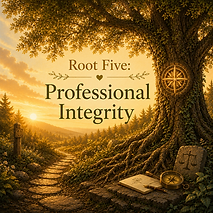
Course 9: Root Five-Professional Integrity
Staying connected to values, ethics, and alignment in real working conditions.
Professional Integrity is tested not only when the correct choice is obvious, but when values, expectations, relationships, workplace demands, capacity, access, approval, and consequences pull in different directions.
In this course, you will explore how to remain connected to professional responsibility, Deaf-centered access, ethical commitments, role clarity, boundaries, and the impact of your decisions under real working conditions.
Professional Integrity is not moral perfection. It is the ongoing practice of noticing tension, examining responsibility, making a grounded choice, and remaining willing to reflect, repair, and change direction.
Course takeaway:
Integrity is not never facing tension. It is staying connected to values, impact, and responsibility while choosing what comes next.
Planned Resources
-
Short self-paced video lessons
-
Guided reflection prompts
-
Downloadable Course 9 workbook
-
Professional Integrity Compass
-
Values Clarification Tool
-
Integrity Reflection Tool
-
Values, Ethics, and Approval comparison
-
Role, Responsibility, and Boundary Map
-
Professional Tension Mapping Tool
-
Integrity Under Pressure scenarios
-
Impact and Accountability Reflection
-
Grounded Decision Pathway
-
Values-to-Action Plan
-
Return-to-Integrity Checklist

Length:
Price: $
Format: Self-paced online course
Access: 45 days
Course 10: Integration-Building a Sustainable Work-Esteem Practice

Bringing the whole framework together into an ongoing professional practice.
Work-Esteem is not completed in one course, one workshop, or one successful season. It is built through repeated returns to reflection, responsibility, support, practice, repair, and professional alignment.
In this final foundational course, you will bring together Growth, Value, Place, identity and performance, Meaning Attachment, the Performance Trap Loop, sustainability, and all Five Roots of Work-Esteem.
You will identify the patterns that most affect your professional steadiness, recognize the conditions that support you, and develop a personal Work-Esteem Practice Plan. The purpose is not to create one perfect plan. It is to build a set of return-to tools that can continue evolving across assignments, roles, workplaces, and seasons of professional life.
Course takeaway:
Work-Esteem is sustained through repeated, responsible returns, not one final achievement.
Planned Resources
-
Short self-paced video lessons
-
Guided reflection prompts
-
Downloadable Course 10 Integration Workbook
-
Whole Work-Esteem Framework Map
-
Course Series Reflection Portfolio
-
Updated Growth, Value, and Place Snapshot
-
Five Roots Integration Check
-
Meaning Attachment Review Tool
-
Performance Trap Early Warning Plan
-
Sustainability Return Plan
-
Personal Support Ecosystem Map
-
Personal Work-Esteem Practice Plan
-
90-Day Action Plan
-
Quarterly Return-to-Practice Template
-
Pocket-sized Rooted Return Tool