The Work-Esteem Framework
A sustainable way to understand professional growth, value, and place.
Work-Esteem is a framework for understanding how professionals experience themselves inside their work.It helps name what often stays invisible: confidence, belonging, feedback, repair, identity, role clarity, and the conditions that shape whether people grow or shut down.
What Is
Work-Esteem?
Work-Esteem is how interpreters and professionals understand their growth, value, and place within their work.
It is not the same as self-esteem.
Self-esteem is connected to how we understand ourselves as people. Work-Esteem is connected to how we understand ourselves within a professional role, a work culture, and a system of expectations.
Work-Esteem is shaped by experiences such as feedback, mistakes, mentorship, belonging, team dynamics, communication, identity, and the meaning we make from what happens in the work.
Work-Esteem asks:
“How do I understand myself inside this work?”


© Work-Esteem Studio. Framework and visual model developed by Katrina N. Wadsworth. Do not copy, reproduce, teach, adapt, or distribute without written permission.
Growth, Value, and Place
The Three Core Questions
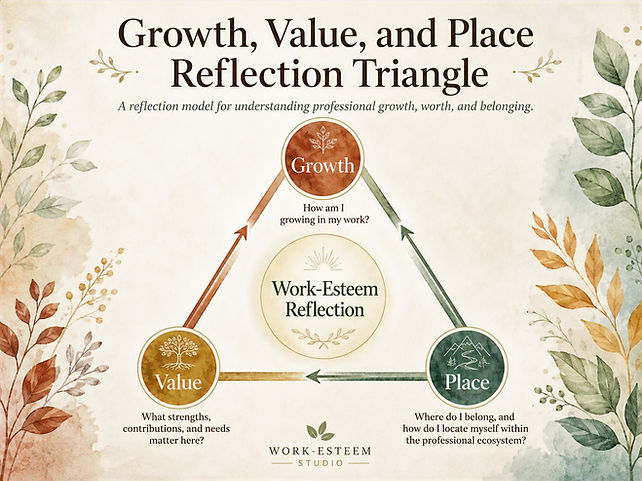
At the center of Work-Esteem are three core experiences: growth, value, and place.
Growth
How am I developing over time?
Growth includes skill, judgment, reflection, learning, repair, and professional capacity.
Value
How do I understand my contribution?
Value includes worth, impact, legitimacy, confidence, and how feedback lands in the body.
Place
Where do I belong in this work?
Place includes role clarity, professional identity, team relationships, belonging, and connection to the communities served.
When growth, value, or place feel threatened, professionals may move into survival patterns. When they are supported, sustainability becomes possible.
Self-Esteem
vs
Work-Esteem
Self-Esteem and Work-Esteem Are Connected, But Not the Same
A person can have strong self-esteem and still struggle with Work-Esteem.
You can know you are a good person and still question your competence after a hard assignment.
You can feel grounded in your personal life and still feel uncertain when feedback, conflict, mistakes, or team dynamics touch your professional identity.
Work-Esteem gives us language for that difference.
Reflection prompt:
What parts of your work have you accidentally treated as proof of who you are?


Belonging
The felt sense that you have a place in the work, the team, and the professional ecosystem.

Trust
The ability to rely on yourself, your process, your colleagues, and the conditions around the work.

Repair
The skill of returning to alignment after harm, disruption, misunderstanding, or rupture.
The Five Roots of Work-Esteem
Work-Esteem grows through five interconnected roots. Each root supports a more grounded, sustainable, and human way of practicing.

Practice
The ongoing development of skill, reflection, feedback, learning, and professional growth.

Professional Integrity
The grounded commitment to ethical, responsible, and sustainable practice.

The roots are not separate boxes. They grow into each other. Belonging supports trust. Trust makes repair possible. Repair protects practice. Practice strengthens integrity. Integrity helps the whole ecosystem hold.
From Survival Mode
vs
Sustainability Mode
Work-Esteem is shaped by more than individual confidence. It is shaped by the conditions around the work.
When professionals experience unclear expectations, repeated criticism, isolation, unsafe feedback, role confusion, or unresolved harm, they may move into survival mode.
Survival mode can look like overworking, shutting down, avoiding feedback, proving yourself, people-pleasing, defensiveness, or disconnection.
Sustainability mode looks different.
It includes reflection, boundaries, repair, role clarity, support, learning, and the ability to stay connected without losing yourself inside the work.
Survival mode is often a response to conditions, not a personal failure.


Repair in the Ecosystem
Repair Is What Makes Growth Possible
Repair is not about avoiding mistakes.
Repair is about what happens after something goes wrong, feels tense, causes harm, creates confusion, or interrupts trust.
In the Work-Esteem framework, repair happens in two connected ways:
Individual Repair
The internal process of reflection, meaning-making, learning, and integration.
Relational Repair
The shared process of communication, clarification, accountability, and rebuilding connection when it is safe and possible.
Both matter.
Individual repair sustains the person.
Relational repair sustains the profession.
Why Work-Esteem Matters
Interpreting and relational professional work are complex. They are shaped by language, culture, identity, power, responsibility, feedback, emotion, and human unpredictability.When Work-Esteem is unsupported, people may begin to fuse their identity with their performance. A hard moment becomes “I am bad at this.” Feedback becomes threat. Mistakes become proof. Silence becomes survival.When Work-Esteem is supported, people can stay more grounded. They can reflect without collapsing, receive feedback without losing themselves, repair without shame, and keep growing with integrity.
Work-Esteem helps professionals stay human inside complex work.